

Your Google Calendar Is Missing One Thing: Buffer Time
This one calendar setting made my week feel lighter.


Most people do not have a time management problem. They have a transition problem.
Their calendar looks neat. Their day does not.
On screen, it is a clean row of 30-minute calls, one-hour meetings, and tidy little blocks that make life look under control. In real life, it is context switching, running late, grabbing coffee, finishing one thought while the next meeting starts, and trying to sound intelligent before your brain has even caught up.
That is why so many people look organized and still feel behind.
The calendar says 10:00 to 10:30.
That gap is where most days quietly fall apart.
The feature I wish more people used
Google Calendar has a setting called Speedy meetings.
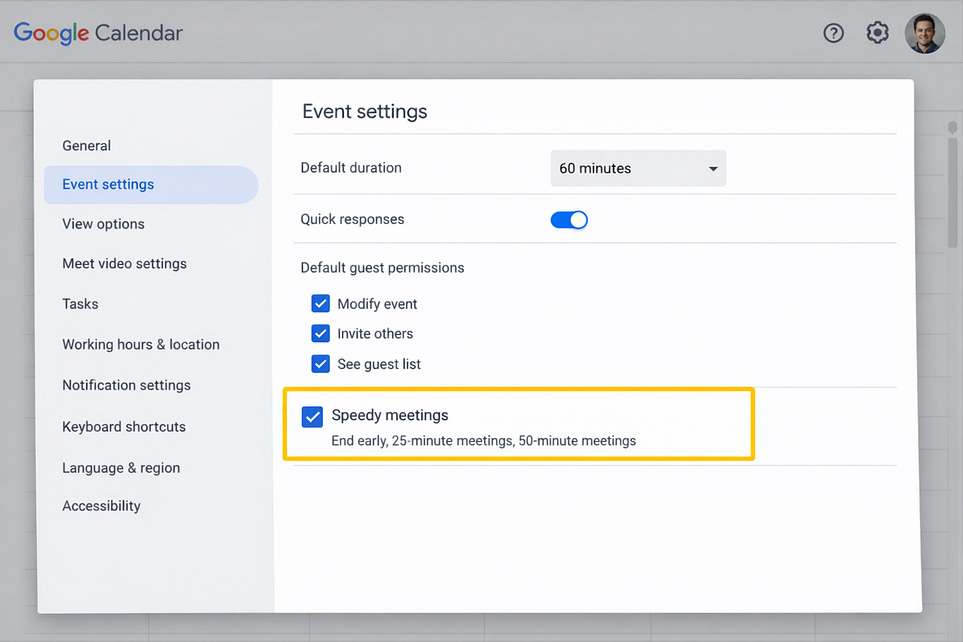
It is tucked away in the settings and does something very simple: it automatically shortens meetings. Google says it cuts meetings by 5 minutes, or by 10 minutes for longer ones, depending on the event length.
That does not sound life-changing.
It sounds like a tiny admin setting you ignore while chasing bigger fixes.
But this is exactly the kind of feature that matters, because it solves a boring problem that keeps ruining otherwise good days.
Not the meeting.
Not the calendar.
The lack of air between things.
Why this matters more than most productivity tips
Most overloaded people do not need help squeezing in one more thing. They need help making the day feel less like a relay race with no baton handoff.
When every meeting ends exactly when the next one begins, you create a schedule that only works in theory.
There is no room to think.
No room to note action items.
No room to walk to the kitchen, refill water, or use the bathroom like a civilized person.
No room to recover from a draining conversation before you enter another one.
And then people wonder why they are tired by lunch.
It is not always the amount of work.
Sometimes it is the friction of nonstop switching.
That is why this setting works.
It quietly puts buffer time back into the system.
What changes when you turn it on
The obvious change is shorter meetings. The real change is better transitions.
A 30-minute meeting becomes 25 minutes. An hour meeting becomes 50. Google also encourages ending meetings a few minutes early to give people time to reset between back-to-back calls.
Those five or ten minutes are not dead time.
They are the minutes that stop your whole day from turning sloppy.
You use them to finish notes while the conversation is still fresh.
You use them to stand up and break the weird trance that comes from staring at faces on a screen all morning.
You use them to breathe before the next thing starts.
You use them to avoid carrying the stress from one meeting into the next.
This is not glamorous.
It is just useful.
And useful beats glamorous every time.
Three ways this helps in real life
1. It reduces fake urgency
When every meeting touches the next one, everything starts to feel urgent.
You are always rushing. Always slightly late. Always mentally somewhere else.
A built-in buffer cuts that edge off.
The day feels less brittle.
2. It makes meetings tighter
People tend to use whatever time they are given.
Give a meeting an hour, and somehow the conversation will grow to fill an hour.
Give it 25 or 50 minutes, and people often get to the point faster.
Less wandering.
Less throat-clearing.
Less “before we wrap” followed by another ten minutes of talking.
Not every time, but often enough to matter.
3. It protects you from your own bad habits
A lot of people overschedule themselves because the calendar allows it.
If a slot looks available, they fill it.
Speedy meetings introduce friction.
That friction is good.
It makes it harder to stack your day like a tower that collapses by 2 PM.
The rule that makes this actually work
Here is the key part.
Do not use the extra five or ten minutes to cram in more work.
That defeats the whole point.
If you turn shorter meetings into tiny pockets for email, Slack, or one more “quick thing,” you are just repackaging stress.
Use the extra time for one of these three things:
capture notes
reset your brain
move your body
That is it.
This works because it creates recovery, not because it creates more capacity to stuff things in.
When not to use it
Not every meeting should be shortened. Some conversations need space.
A serious strategy discussion, a difficult one-on-one, a planning session with real decisions, these may deserve the full time.
That is fine.
The point is not to turn every conversation into a sprint.
The point is to stop treating one-hour meetings as the default for everything.
Most meetings are longer than they need to be.
That is just the truth.
How to turn it on?
Google points users to this setting in Calendar under Settings > Event settings > Speedy meetings. It can shorten meetings by 5 or 10 minutes, depending on the event length, and Google also recommends ending meetings a few minutes early to reduce back-to-back meeting fatigue.
It takes less than a minute to switch on.
Which is funny, because some of the best improvements in a workday are like that.
Not dramatic.
Not expensive.
Not a new system.
Just one small setting that makes your day behave more like a human day.
The bigger point
This is not really a post about Google Calendar.
It is a post about margin.
Most people are not failing because they lack ambition, discipline, or productivity apps.
They are failing because their day has no white space.
No breathing room.
No transition time.
And when a day has no space, even simple things start feeling heavier than they should.
That is why I like this feature.
Not because it helps me fit in more.
Because it helps me move through the day without feeling chased by it.
And that is a much better standard for productivity.