

The Morning Chant That Finally Worked
The three-word ritual I still use and why it isn’t arrogant?

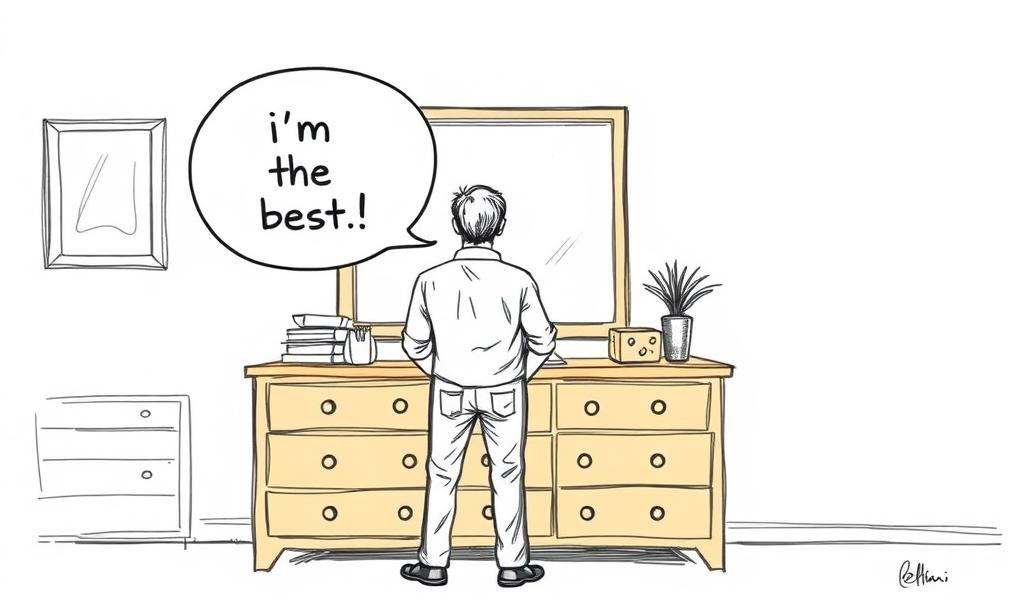
Most mornings used to start with a knot in my chest. Not because life was terrible—but because I carried an old, familiar weight: you’re not enough.
Too quiet.
Too behind.
Too late.
I was forever measuring myself against a scoreboard only I could see, and still somehow losing. Then, almost by accident, I tried a tiny experiment. I stood in front of the mirror and said three words out loud:
“I am the best.”
It felt silly. It felt un-Indian, un-humble, un-me. But I kept saying it anyway—softly at first, then steadily, like a drumbeat I could march to. And something shifted.
This is the story of that shift—and how you can borrow it tomorrow morning.
I was an introvert who overthought every glance and comment. The world felt like a never-ending audition. Somewhere along the way, striving turned into self-surveillance. I learned to scan for flaws before I looked for strengths.
That soundtrack ran for years.
In my late thirties, I wandered into a bookstore and picked up a slim title on affirmations. It wasn’t a lightning bolt. But it was a nudge. I took one idea home: when your inner critic speaks on loop, you need a louder, kinder loop.
That’s how the mirror practice began—awkward, mechanical, and strangely confronting. Eye contact with myself felt like holding a stare with a stranger I had judged too harshly. Still, I stayed with it.
“I am the best.”
Before you roll your eyes, a clarification: my chant wasn’t “I’m better than you.” It was “I am the best me available today. The me who shows up. The me who tries.”
That nuance made it livable.
Long before the bookstore, my brain was a foggy soup of dates and doubt. I remember whispering something to steady myself—some early ancestor of the chant. Back then, I didn’t have a ritual. But I did have a hunch: the words I feed my mind tilt my day.
Years later, when the actual mirror practice started, that old hunch finally got a spine. I brought the phrase back, this time on purpose, every morning.
And the graph of my days started bending.
What Changed (Slowly, then Obviously)
At first, nothing dramatic. Just a 2-degree turn:
I noticed my strengths before my shortcomings.
I set smaller goals and actually hit them.
I walked into rooms not to impress but to be useful.
“You become what you believe, not what you think or what you want.” Oprah said that, and it tracks. Belief isn’t wishful thinking; it’s your brain’s marching orders. When my orders changed, my posture followed.
You don’t become what you want—you become what you believe. In this powerful motivational speech inspired by Denzel Washington, you’ll learn how to change your mindset, reprogram your belief system, and unlock the potential that’s already inside you.
A week into the chant, three weeks in, I caught myself celebrating tiny wins.. Five months in, I handled a tricky conversation with calm I didn’t know I had.
None of this made me invincible. It made me steadier.
Why This Works?
You don’t need a neuroscience degree for this. Just three simple truths:
Your brain is plastic. It rewires based on repetition. Repeat “I’m the best (me)” daily, and your brain starts treating it like a standard setting rather than a motivational poster.
Your attention is a bouncer. There’s a little system in your brain called the Reticular Activating System (RAS) that decides what gets in. Tell it what matters, and it will start spotting evidence to match. Say “I am the best,” and it nudges you to notice your best efforts, not just your worst moments.
Action cements belief. The chant is the spark; small wins are the oxygen. When you act in line with the words—even in baby steps—the loop strengthens.
No magic. Just mechanics.
The Day It Proved Itself
There was a stretch where life was loud—family worries, career uncertainty, too many spinning plates. Old me would have hidden in busyness.
The mirror-me did something else:
I pared the day down to one meaningful task, said the line, and started there.
“I am the best.”
Not the best on LinkedIn. Not the best compared to someone’s highlight reel. The best version available at that hour.
That day went better than it had any right to. Not because everything worked. Because I did.
A week later, a complicated conversation was resolved well, a project moved forward, and a small promise to myself was kept. That last one mattered most.
Isn’t This…“Arrogant?”
I get this a lot. The answer is simple: Humility is truth. If the truth is that you showed up, prepared, and tried with integrity, then claiming your best effort isn’t arrogance—it’s accuracy.
My chant never excused sloppiness. It demanded effort. On the days I mailed it in, the mirror was honest: the best me shows up, so let’s show up.
“Dreams are not what you see in sleep; they are the things that do not let you sleep.” Shahrukh Khan’s line lives rent-free in my head. For me, the chant turned dreams into daily behavior: fewer fantasies, more reps.
Once I started treating myself with basic respect, my circle changed, too. People who thrived on subtle put-downs or chronic drama drifted. People who were doing the work—quietly, consistently—moved closer.
The chant made me a better friend and collaborator. When you’re not running a private competition in your head, it’s easier to spot someone else’s brilliance and say, “More of that, please.”
Try This Tomorrow Morning
If you want to test this, don’t overengineer it. Give yourself five quiet minutes.
Stand somewhere private—mirror or no mirror—your call.
Pick your phrase. Steal mine if you like: I am the best. If that feels off, try: I’m the best version of me today, or I can do today’s work well.
Say it out loud. Three slow repetitions, eyes open. Breathe between them.
Pair it with one action. What’s the smallest move a “best you” would make before 9 a.m.? Do that next.
Log the proof. Jot one line: “Where did I act like my best today?” Over time, this becomes a quiet evidence file.
If you miss a day, no drama. Return to the mirror. Return to the line.
What do I Tell My Past Self Now?
You don’t owe the world a performance. You owe yourself a fair shot.
Those three words—I am the best—didn’t make me superhuman. They made me honest. They replaced a hostile default with a helpful one. And that small, stubborn ritual has outperformed every hack I’ve tried.
If this lands with you, try it for seven mornings. See what bends. Notice how your tone with yourself softens. Notice how your choices sharpen.
Then tell me what happened.
Now, Your Turn
What’s one line you could live with for a week? Drop it in the comments or hit reply and share privately. If you already have a morning phrase, I’d love to hear how it’s shaped you.
I’ll go first, one more time, because saying it never gets old:
I am the best.
P.S. If this helped, consider forwarding it to one person who’s too hard on themselves. Sometimes the right line, at the right time, changes a day.