

The Expensive Mistake Most Startup Founders Make in Year One (And Why It Is Not What You Think)
Most founders blame product, pricing, or timing. The real culprit is much earlier and much cheaper to fix.

A founder walked into a call with me about eight months into running his SaaS startup.
He had a product that genuinely worked. His NPS scores from early users were solid. He had closed eleven paying customers. But he was burning through runway faster than he expected and couldn’t figure out why growth had stalled.
I asked him one question.
“Who, exactly, is your customer?”
He smiled and leaned back. “Anyone who manages a team and wants better communication. Could be a startup, could be an enterprise. We’ve sold to a construction company, a law firm, a software team in Austin, a marketing agency in Chicago.”
I nodded. Then I asked a follow-up.
“Of those eleven customers which one would be most devastated if your product disappeared tomorrow?”
He replied after a long pause. “I’m not sure any of them would be devastated. They’d find something else.”
That was the real problem.
Not the product.
Not the pricing.
Not his marketing.
The problem was that he had spent eight months selling to anyone who would listen, and in doing so, had built a product that was mildly useful to many people and deeply essential to no one.

The mistake founders think they’re making vs. the one they’re actually making
Ask most early-stage founders what’s going wrong in year one, and you’ll hear a familiar list.
The pricing isn’t right.
The product needs one more feature.
The market timing is off.
They need better salespeople or a bigger LinkedIn following.
These aren’t wrong, but they’re symptoms. I’ve watched sink promising startups over and over again in my twenty-plus years in SaaS; it’s almost always the same. They never decided who they were actually for. I mean, they never sat down and got so specific about their ideal customer that they could describe a real, named person, and their role.
Without that, everything downstream suffers.
Your messaging tries to speak to everyone and reaches no one.
Your product roadmap becomes a hostage negotiation between the conflicting requests of wildly different customers.
Your sales cycle stretches because you can’t articulate the one reason this specific person should care.
And you burn time and money chasing logos instead of building loyalty.
Why founders avoid this
Here’s what makes this mistake so seductive: saying yes feels like progress. When a construction company reaches out, and your product kind of fits their workflow, it is genuinely exciting.
Revenue is revenue.
Traction is traction.
You tell yourself you’ll figure out the focus later, once you have more data.
But later never comes because you now have a customer in construction who needs a specific integration. And a law firm that needs different compliance language in its contracts. And a marketing agency is asking for a feature that would actively break the workflow you built for the software team in Austin. You’re not growing. You’re accumulating complexity.

I saw this pattern up close with a startup I was advising a few years ago. They had a genuinely interesting AI-driven tool for internal knowledge management. In month one, they sold to a healthcare company, a consulting firm, and a fintech startup. Three customers. Three completely different security requirements, data models, and use cases.
By month nine, the founding team was spending 60% of their time on customization for existing customers. They had no bandwidth to acquire new ones. The product was technically impressive and strategically adrift.
We eventually did the painful work of picking one. They went deep on mid-size consulting firms. Rebuilt their messaging around that buyer’s specific language. Rewrote their onboarding to align with that buyer’s specific workflow.
Within six months, they had doubled their customer count by talking to fewer types of people.
What an ICP actually is (and isn’t)
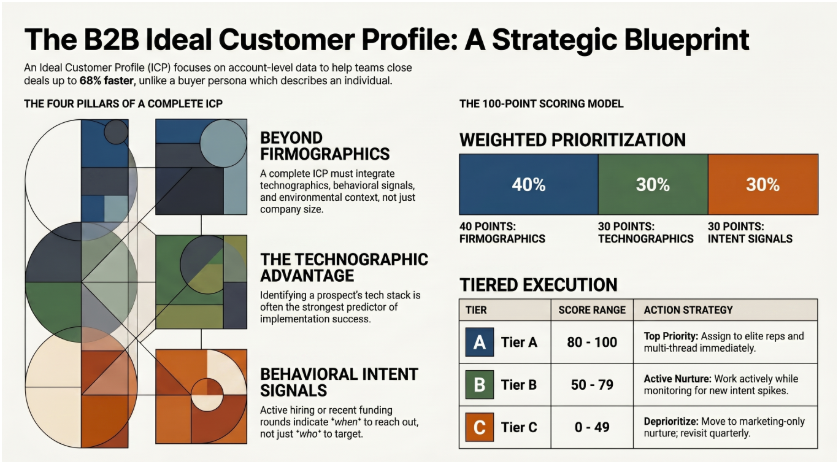
Most founders have heard the term Ideal Customer Profile (ICP). Fewer understand what it should actually look like in practice.
It is not a demographic box. “B2B, mid-market, North America, tech sector” is not an ICP. That’s a filter. It tells you where to look, not who to talk to.
A real ICP is a portrait. It answers questions like: What does this person’s week look like before they found your product? What are they losing — time, revenue, credibility — because of the problem you solve? Who else inside their company has to say yes before they can buy? What have they tried before, and why did it fail?
When you get this specific, something strange happens.
Your outreach starts getting replies. Not because you said something clever, but because the person on the other end thinks you’ve been reading their diary. Your product decisions become easier because you have a single customer reality to anchor against. Your team stops arguing about which feature to build next, because the answer is usually obvious.
And perhaps most importantly, you start building something that someone would genuinely miss.
A simple way to find your real ICP if you already have customers
If you have even a handful of paying customers, you already have enough data to do this. You don’t need a research firm.
Look at your existing customers and find the one who got the most value, required the least hand-holding, renewed without pushback, and has referred someone else or at least mentioned you to a peer. That person is not a coincidence. They are a signal.
Now write down everything you know about them. Their role. Their company size. Their industry. The specific problem they came to you with. How they described that problem in their own words — not your words, theirs.
Then ask yourself honestly: if you had twenty more customers exactly like them, would you have a business you were excited to run?
If yes, that’s your ICP. Go find twenty more of that exact person before you try to sell to anyone else.
If not, the honest answer is that your current best customer isn’t actually that attractive a customer, then you have a different conversation to have. But at least you’re having it now, in year one, instead of year three when the runway is gone.
The thing I always tell founders at the end of this conversation
Narrowing feels like loss. It feels like you’re shutting doors. What you’re actually doing is building a hallway that leads somewhere.
The startups I’ve watched scale not just survive, but genuinely scale, almost always went through a phase where they felt dangerously focused. Where someone on the outside might have said, “why are you only talking to VP of Customer Success leaders at Series B SaaS companies? Doesn’t that limit your market?”
That focused phase is not a limitation. It’s where the product gets sharp. It’s where the messaging gets memorable. It’s where your first twenty customers become your best salespeople, because they feel genuinely seen by what you built.
The funny thing about trying to sell to everyone is that you end up meaning something to no one.
Pick someone. Go deep. Then expand.
Hidden Tax Your Startup Pays Every Friday Night

It’s 10:00 pm on a Friday. You closed the laptop two hours ago. You’re standing in the kitchen, the kettle is on, your kid is yelling about Lego, and your brain pulls up a file you didn’t ask for.
If this hit close to home, I’d love to hear which part resonated. Reply and tell me as I read every response.
And if you know a founder who is in the middle of this mistake right now, the kindest thing you can do is forward this post to them
Anshul Kumar writes about business strategy and calm execution for founders and operators at Calm Productivity — the space where commercial thinking and sustainable performance meet. 30 years in SaaS. Two exits. No hustle-culture noise. → anshulkumar.substack.com