

The Day I Stopped Beating Procrastination
A slight shift that turned “I’ll start tomorrow” into steady progress.

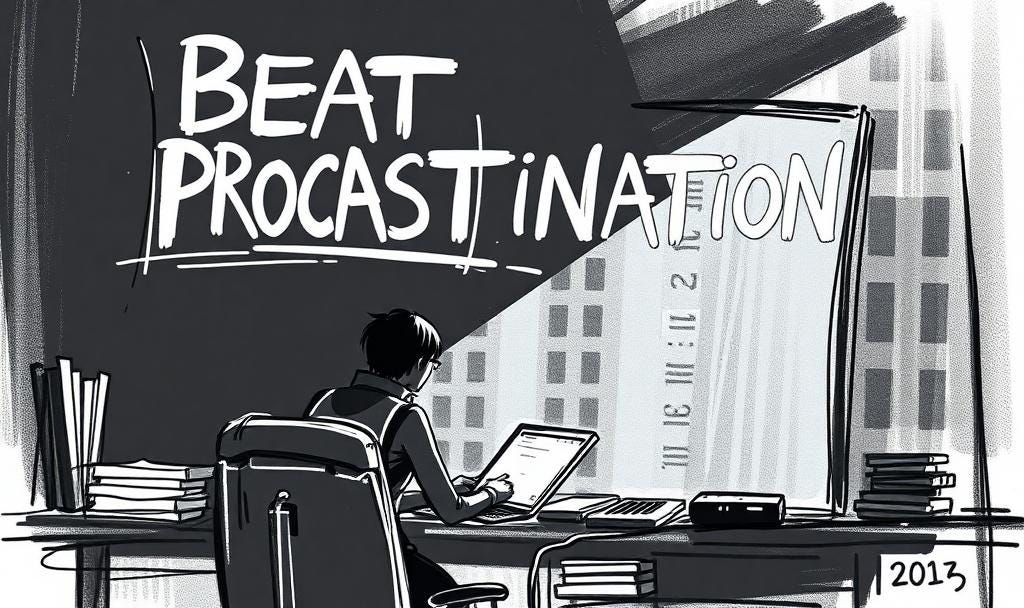
I’d open a document, type the title, and then—like clockwork—fall into a rabbit hole of looking at some stupid YouTube videos and refrigerator cleaning. The guilt arrived first.
Then the promise: Tomorrow I’ll start. Tomorrow never RSVP’d.
The to-do list watched me with that smug, paper-thin smile. I was convinced the fix had to be more discipline, more hours, more grind.
And then something ordinary broke the spell.
I was out for a walk—no podcast, no plan—when an answer to a stuck problem surfaced on its own. It felt like my brain had been marinating the idea while I was busy trying not to think about it.
That moment gave me a simple experiment: instead of fighting procrastination, I’d work with it.
I understood that “Intentional Pauses” are not laziness
I started scheduling small, guilt-free pauses. The intentional ones.
Read three pages of a book.
Stare out the window and name five things I can see.
Put on one song and listen to it.
Take a slow lap around the block.
At first, it felt ridiculous. Productivity, I thought, meant squeezing every spare second until it squealed. Turns out, it means rhythm.
The more I honored these short, deliberate pauses, the less my work felt like lifting wet cement. My ideas showed up sooner. My focus held longer. The stress dial turned down a few notches.
I kept at it for three months. It stuck.
What Actually Worked?
1) Map the Triggers
I wrote down when procrastination ambushed me: after lunch, at the blank-page moment, and when a task felt oddly vague—seeing the pattern killed half the power.
Tiny rule: When a task is vague, I write the first physical action on a sticky note: “Open slide 3 and rename it.” My brain can’t argue with that.
2) Build “Drift Windows”
I gave myself 10–15 minute pockets between 60–90 minute focus blocks to drift on purpose. Stretch, sip water, look at the sky, fold two shirts, anything light and finite. It scratched the itch before it became a binge.
Guardrail: Timer on. When it dings, I start the next action I had written down earlier. No debate.
3) The 3-Minute Reentry
If I didn’t want to resume, I did it for three minutes anyway. I let myself quit after that if it still felt awful.
Spoiler: after three minutes, quitting rarely made sense.
4) Make Distraction Expensive
I signed out of the stickiest sites, put them on the second screen’s last desktop, and moved my phone across the room. This served as little more than a speed bump.
5) Finish Line Rituals
When done, I closed the loop: wrote a one-sentence log (“Draft done. Next: tighten intro”), tidied my workspace for 60 seconds, and picked tomorrow’s first action. Future-me thanked past-me. Loudly.
Why This Works (No Jargon, Just Honest Brain Stuff)
Your brain isn’t a bulldozer; it’s more like sourdough. It needs periods of mixing, resting, and rising.
My old approach was all mixing, no rise. The pauses gave me rise time—space for background processing and creative connection—without letting me slide into a void.
Procrastination didn’t vanish. It got repurposed.
A One-Week Rhythm Reset (Copy/Paste Friendly)
Day 1 (10 min): List three moments you typically procrastinate. For each, write the following physical action.
Days 2–7: Run this loop twice a day.
Focus 60–90: Work on one task. When stuck, write the following physical action.
Drift 10–15: Intentional pause (walk, song, window). Timer on.
Re-enter 3: Do only three minutes of the following action. Decide if you continue.
Finish Line 2: Log one sentence: “What’s done / What’s next.”
By the end of the week, you’ll feel a cleaner cadence—not perfect, just steady.
What I Stopped Doing
If I had nothing, I would have written the ugliest first sentence on Earth. Momentum > pride.
Short sprints, short rests. Repeat.
Sometimes your brain needs a sip of air. Let it take one—on purpose.
The Takeaway
Procrastination isn’t always the villain. Sometimes it’s a nudge: step back, breathe, let your mind do its quiet job. If you give it a healthy lane—short, intentional pauses—it stops hijacking the whole highway.
You’re not lazy. You’re learning your rhythm.
If this resonates, try the one-week reset. Hit reply and tell me where procrastination trips you up most. I’ll share patterns I’m seeing from readers in a follow-up.
— Anshul
11 Productivity Secrets That Actually Work (No Gimmicks, Just Results!)

Countless productivity hacks are floating around the Internet. Ironically, exploring all these tips often becomes a way to procrastinate.

Loved this perspective! The idea of ‘intentional pauses’ is brilliant.