Stop Optimizing Your Mornings. Fix Your Nights
The morning routine gets all the credit. The night before does all the work.

A few months ago, I was on a coaching call with a founder who had Notion, Todoist, a physical planner, and a sticky-note wall. Four systems. He could not ship a single deliverable on time.
I asked him one question: "What do you do the night before a big workday?”
There was a long pause first.
“I scroll for a bit and then fall asleep.”
That was the whole answer. And it explained everything.
Here is what I want you to walk away with today. The ten minutes before you go to sleep are the highest-leverage productivity minutes of your entire day. Most people waste them completely.
The Morning Routine Myth

The internet is obsessed with mornings. Cold plunges. Journaling. Meditation. Gratitude. Exercise. All before 7 AM. The promise beneath it all is that if you nail your morning, the rest of the day falls into place.
I am not against any of those habits. Some of them are genuinely useful.
But here is what nobody tells you. A great morning routine cannot compensate for an unplanned night. If you wake up without knowing exactly what matters today, you will spend the first two hours of your “optimized morning” just figuring that out. By the time you reach your desk, the cognitive energy you needed for real work is already gone.
Your morning routine is the performance. The night before is the rehearsal. Nobody skips rehearsal and then wonders why the show falls apart.
What Your Brain Is Actually Doing While You Sleep
Researchers at Baylor University conducted a study in which participants spent 5 minutes writing before bed.
One group wrote down tasks they had already completed.
The other wrote a to-do list for the next day. The result? The to-do list group fell asleep an average of 9 minutes earlier, a difference comparable to that of some pharmaceutical sleep aids.
The lead researcher, Dr. Michael Scullin of Baylor’s Sleep Neuroscience and Cognition Laboratory, described it as “offloading” the open loops in your head so your brain stops cycling through them at 2 AM.
The story does not stop at falling asleep faster. Research on sleep and memory consolidation, published across multiple studies in peer-reviewed journals, shows that the brain actively reprocesses and strengthens the experiences and information it encountered before sleep.
Put plainly: the inputs you give your brain before sleep get prioritized overnight. If the last thing you do is scroll through a random feed, that is what gets processed. If you write down your three priorities for tomorrow, those get processed.
You wake up not just rested. You wake up pre-loaded.
My 10-Minute Night System
I have run this for years. It survived international travel, product launches, and a company exit. It has three steps and takes ten minutes on a slow night, five on a sharp one.
Step 1: Brain dump. (2 minutes.) Open a notebook or a blank doc. Write everything still running in your head. Unfinished tasks. Worries. Follow-ups. Half-formed ideas. Get it out. This is the step most people skip, and it is the most important. You are clearing RAM, so your brain stops running background processes all night.
Step 2: Name your three non-negotiables. (3 minutes.) Not a to-do list. Not a schedule. Three things that, if done tomorrow, make the day a win. That is it. I am ruthless about the limit because when everything is a priority, nothing is. Three forces a real decision about what actually matters.
Step 3: Set the stage. (2 to 3 minutes.) Close your tabs. Put your phone across the room. Lay out whatever you will need first thing in the morning. I learned this from years of leading revenue teams. The environment you wake into should make the right action the path of least resistance. Remove the friction before it can slow you down.
The last two minutes: Read something that has nothing to do with work. Fiction. History. A poem. Not as a productivity tactic. Just as a person who deserves to end the day quietly.
The Thing I Got Wrong for Years
Here is my honest confession. I spent the first decade of my career optimizing the wrong end of the day.
I read every book on morning routines. I tried 5 AM wake-ups. I built elaborate systems that collapsed by Thursday. The problem was not discipline. The problem was that I kept arriving at those mornings with no clear target. I was polishing the launch pad while ignoring the flight plan.
The night before does not require discipline. It requires two minutes of honesty about what actually matters.
That shift compounded quietly over the years. It is not glamorous. It will not get you on a podcast about 5 AM habits. But it works, and it keeps working. That is the only metric that matters.
The Founder With Four Systems

I will close where I started.
After that coaching call, the founder dropped three of his four productivity systems. He kept the physical planner, but only for the night-before ritual. Two weeks later, he shipped something he had been “planning to start” for two months.
He did not need more tools. He needed ten minutes of intentional thinking before he went to sleep.
What does your night-before look like right now? Are you planning it, or just hoping the morning saves you? Drop a reply. I read everyone.
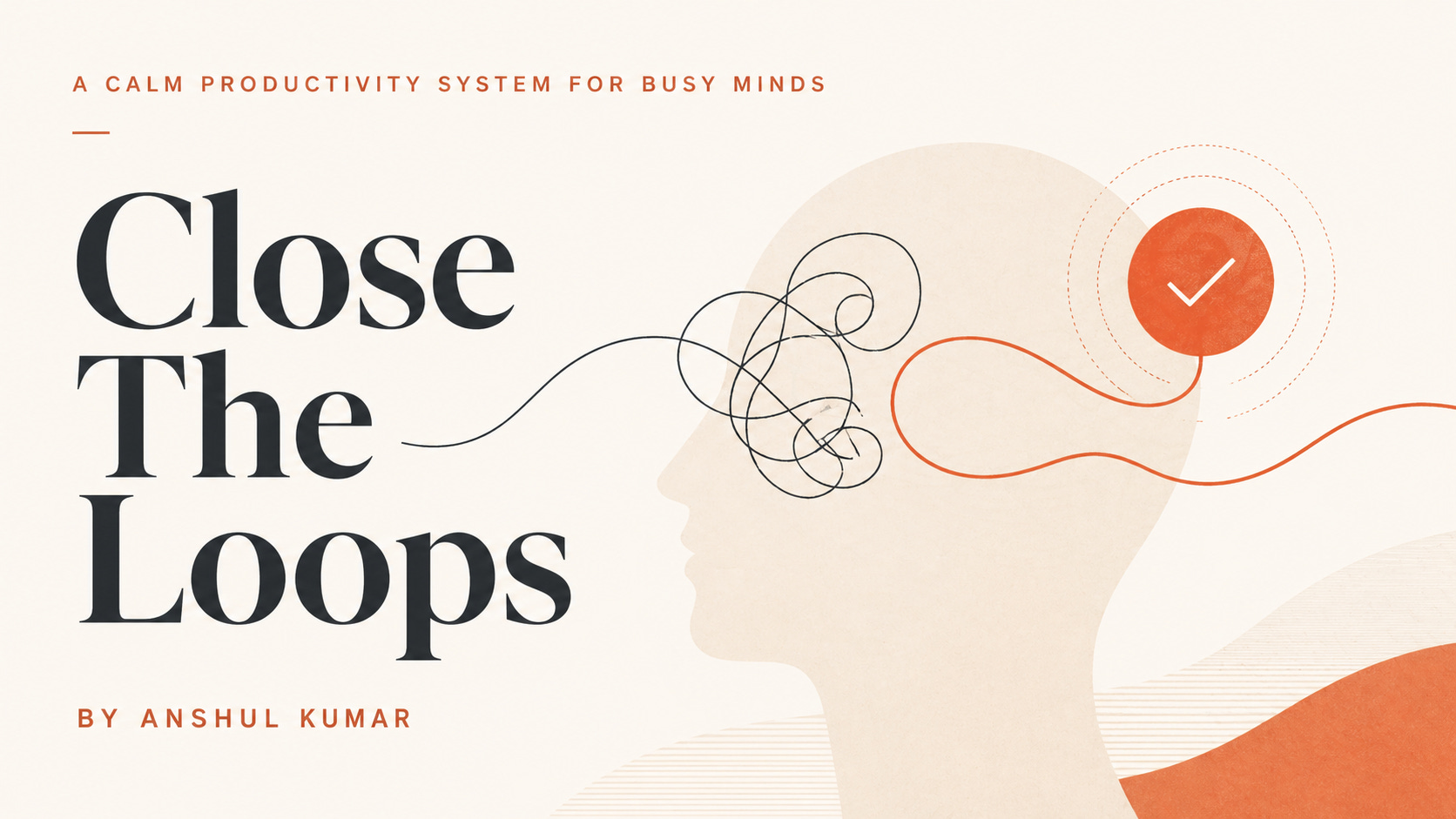
Also, that founder I mentioned at the start? One of the first things I sent him was this book. ‘Close The Loops’ is a calm productivity system for people who are tired of cycling through the same unfinished thoughts every night.
If this post resonated, it will too.